
By Ugochukwu Ugwuanyi
Recent comments by Isaac Omolehin have sparked debate within Nigerian Christian circles about leadership, unity, and the idea of a central “father figure” for the faith community.
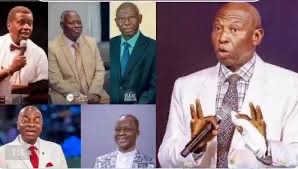
In a viral video, the Ilorin-based cleric questioned whether widely respected leaders across major denominations could truly be considered collective “fathers” of Christianity in Nigeria. His remarks, which referenced figures such as Enoch Adeboye, David Oyedepo, and William Kumuyi, drew criticism from the Christian Association of Nigeria (CAN), which cautioned against statements capable of creating division or misunderstanding.
The controversy raises a broader question: does Nigerian Christianity require a unifying patriarchal figure?
The Idea of a “Father” in the Faith
In many religious traditions, the concept of spiritual fatherhood carries symbolic weight. It represents guidance, mentorship, and continuity. Within Nigeria’s diverse Christian landscape, however, leadership is largely decentralized, with denominations operating independently.
Rev. Omolehin’s remarks appear to reflect a desire for greater cohesion, perhaps through a figure who embodies collective authority across denominations.
Yet such a vision comes with practical and theological challenges.
Diversity Within Unity
Nigerian Christianity is not a single institution but a network of traditions, doctrines, and organizational structures. From Pentecostal ministries to historic denominations, each operates with its own leadership framework and theological emphasis.
In this context, expecting a single individual to function as a universal “father” may overlook the complexity of the system itself.
Even at a global level, Christianity does not operate under a single unified authority across all denominations. Leadership tends to be contextual rather than centralized.
Authority and Responsibility
The debate also touches on the limits of influence. Spiritual leaders are typically responsible for their congregations and spheres of ministry, not necessarily for the entire religious landscape.
Expanding that responsibility to a national or interdenominational level would require not only acceptance but structural alignment, something that currently does not exist.
For this reason, some observers view the expectation of a singular father figure as more aspirational than practical.
Historical Reference Points
The discussion inevitably brings up figures such as the late Benson Idahosa, whose influence extended beyond his immediate ministry. Many contemporary leaders were shaped directly or indirectly by his work, creating a sense of shared legacy.
However, even such influence did not translate into formal centralized authority. It functioned more as inspiration than governance.
This distinction is important in understanding how leadership operates within the Christian community.
Unity Without Centralization
Calls for unity within Nigerian Christianity are not new. They often center on shared values such as doctrine, salvation, and moral teaching rather than institutional hierarchy.
While the idea of a central father figure may symbolize unity, cohesion can also emerge through collaboration, dialogue, and mutual respect among leaders.
In that sense, unity does not necessarily require uniformity.
A Continuing Conversation
The debate sparked by Rev. Omolehin’s remarks highlights ongoing questions about leadership, authority, and identity within Nigerian Christianity.
Rather than settling the issue, it opens space for reflection:
How should unity be defined?
What form should leadership take?
And how can diverse traditions coexist without losing their distinctiveness?
These are questions that extend beyond personalities and into the evolving structure of faith communities themselves.
Editor’s Note
This article is published under Faith & Culture. The views expressed are those of the author and do not necessarily reflect the editorial position of Mirror African Diaspora.
Author Bio
Ugochukwu Ugwuanyi is a Sage, Narrative Architect, and Branding Strategist who writes on faith, culture, and society. He welcomes readers’ feedback via email at ugovesterugwuanyi@gmail.com and on X (formerly Twitter) @sylvesugwuanyi.
