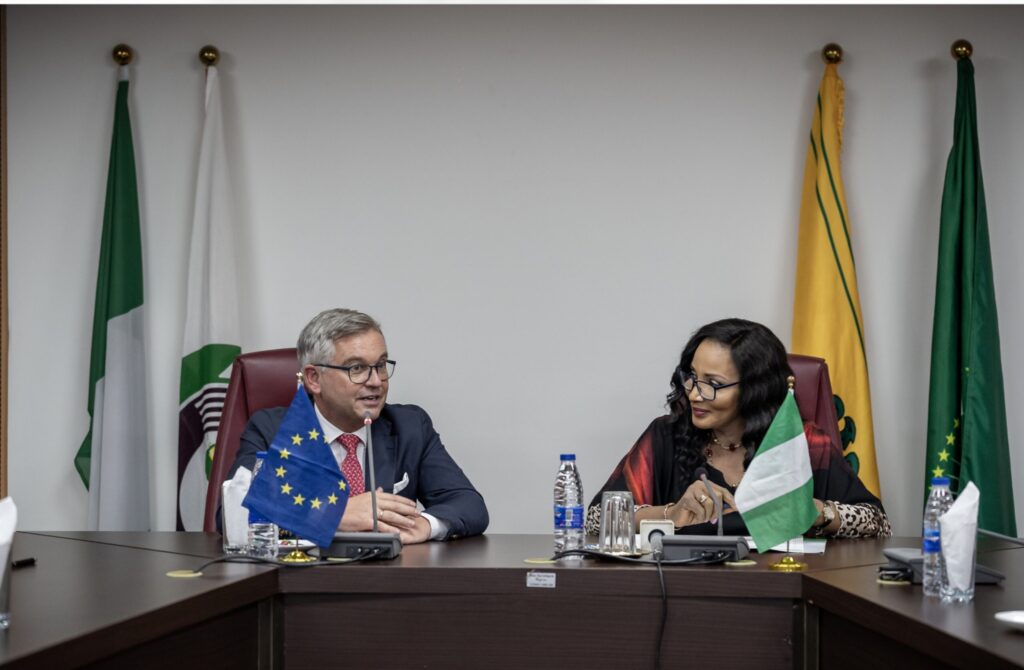
EU Commissioner Magnus Brunner meets Nigeria’s Foreign Affairs Minister, Bianca Odumegwu-Ojukwu, during the signing of the EU-Nigeria Readmission Agreement in Abuja on 10 November 2026. Photo: European Commission
By Robinson Afamefuna Ambrose
Nigeria has agreed to make the return of its citizens from Europe faster and more predictable. Abuja says the agreement could open doors to education, vocational training and legal migration, but the details remain unclear.
For generations of Nigerians, Europe represented the possibility of a different life.
The movement accelerated during the economic crisis of the 1980s. As oil revenues collapsed, jobs disappeared and the Structural Adjustment Programme reduced public spending, Nigerian professionals began leaving in greater numbers.
Doctors, lecturers, engineers, traders and young graduates travelled abroad in search of what became popularly known as greener pastures. Britain was already a familiar destination, but Nigerian communities also grew in Germany, Italy, Spain, France, Belgium and the Netherlands.
The journeys were not always easy. Some travelled legally for education or employment. Others entered through dangerous routes, endured exploitation or remained after their visas expired. Many eventually built families and businesses, while sending money home to support relatives and communities.
The Migration Policy Institute’s account of Nigerian migration links the increase in emigration during the 1980s to Nigeria’s worsening economy and the austerity measures introduced under structural adjustment.
Four decades later, migration between Nigeria and Europe has returned to the centre of political negotiations.
This time, the clearest commitment concerns the journey back.
A deal ten years in the making
Nigeria and the European Union signed a readmission agreement in Abuja on 10 November 2026 after a decade of negotiations.
Nigeria was represented by Foreign Affairs Minister Bianca Odumegwu-Ojukwu, while EU Commissioner for Internal Affairs and Migration Magnus Brunner signed on behalf of the European Union.
According to the European Commission, the agreement establishes procedures for identifying and returning people who do not, or no longer, have the legal right to remain in Nigeria or an EU member state.
In practice, its greatest effect is expected to be on Nigerians who have received final orders to leave European countries.
The agreement does not automatically cancel residence permits, determine asylum applications or remove the right to challenge an individual return decision. Those matters remain subject to national and international law.
What the agreement does is create a formal system through which European authorities can ask Nigeria to confirm a person’s identity, issue the necessary travel documents and receive the individual upon return.
For EU governments seeking to increase deportations, that cooperation is significant. A return order is difficult to enforce when a person’s country of origin cannot be confirmed or refuses to issue travel documents.
Nigeria has now agreed to make that process faster and more predictable.
The agreement is not yet in force
Although the agreement has been signed, it has not yet taken effect.
The EU treaty register confirms that it was signed in Abuja on 10 November, but the ratification process has not been completed.
The European Parliament must give its consent before the Council of the European Union can formally conclude the agreement. Nigeria must also complete its required procedures.
Until that process is finished, the agreement does not provide an immediate legal basis for new returns.
That distinction matters because signing a political agreement and bringing it into force are two different stages.
What did Nigeria secure?
The Nigerian government has presented the agreement as part of a broader partnership rather than a simple deportation arrangement.
In its official statement, the Ministry of Foreign Affairs said the pact reflected Nigeria’s commitment to the welfare and dignified return of its citizens.
Odumegwu-Ojukwu also expressed confidence that it would strengthen cooperation in education, capacity building and vocational training.
Those are important promises, but they remain broad.
The public statement does not identify any new scholarship programme, vocational training scheme or legal route through which Nigerians can apply to enter Europe. It does not state how many places will be available, which EU countries will participate or when applications will begin.
Questions also remain about a reported funding commitment of almost €100 million.
Nigeria’s Federal Ministry of Information and National Orientation reported that an EU official said nearly €100 million had been made available for wider migration and security cooperation.
The ministry said discussions would cover legal migration, border management, anti-trafficking efforts and cooperation against drug smuggling.
However, when the European Commission was questioned about the money, it declined to describe the agreement as an exchange of deportation cooperation for financial concessions.
Euronews reported that the Commission regarded the readmission agreement as one part of a wider relationship with Nigeria. It did not publicly confirm that the reported €100 million was secured in direct exchange for signing the deal.
That leaves a gap between the Nigerian presentation and the European explanation.
Abuja must disclose the terms
Nigeria has accepted clear responsibilities under the agreement. It must now explain the benefits with the same level of clarity.
Is the reported €100 million entirely new funding, or is it part of money the European Union had already allocated to Nigeria?
How much will be spent on reintegrating returning Nigerians?
How much will go towards border control, security agencies and migration administration?
Will any portion create genuine legal pathways for Nigerians seeking employment, education or professional training in Europe?
Which institutions will manage the money, and how will the public know whether it has been properly used?
These questions should be answered before the government presents the agreement as a balanced achievement.
What awaits those who return?
The language of dignified return also requires closer examination.
A person may be returned safely and still arrive in Nigeria with no home, no job and no realistic means of rebuilding a life.
Some returnees will have lived in Europe for many years. Others may arrive with children who have little connection to Nigeria. Some may face stigma, trauma, family rejection or debts incurred during their original journey.
Dignity cannot end at the airport.
The government should explain whether returnees will receive temporary accommodation, psychological support, vocational training, business assistance or help finding employment.
It must also clarify which agency will be responsible for receiving them and how they can apply for assistance.
Without a credible reintegration programme, the agreement could return people to the same unemployment, insecurity and lack of opportunity that encouraged them to leave.
Some may attempt the journey again.
A relationship that must work both ways
Nigeria has a responsibility to receive its citizens when they have exhausted every legal right to remain abroad.
But cooperation should work in both directions.
If Abuja is helping Europe enforce its migration laws, it should also secure measurable opportunities for Nigerians to migrate safely and legally.
That could include work visas, apprenticeships, university placements, professional exchanges and recognised vocational qualifications. These opportunities should be public, accessible and protected from political patronage.
After ten years of negotiations, the obligations surrounding return appear relatively clear.
What remains unclear is what ordinary Nigerians gained in return.
Until Abuja publishes the full terms, identifies the funding and explains the promised legal migration opportunities, the agreement will be judged less by the language used at the signing ceremony and more by a simple question:
Nigeria has agreed to take back its citizens, but what exactly did it secure for them?