
All 62 people linked to Nigeria’s first confirmed Ebola case in more than a decade have completed monitoring without testing positive. It is a major public health success, but the imported case also raises a difficult question: Is Nigeria prepared to detect the next infected traveller before the virus reaches a hospital or community?
By Robinson Afamefuna Ambrose
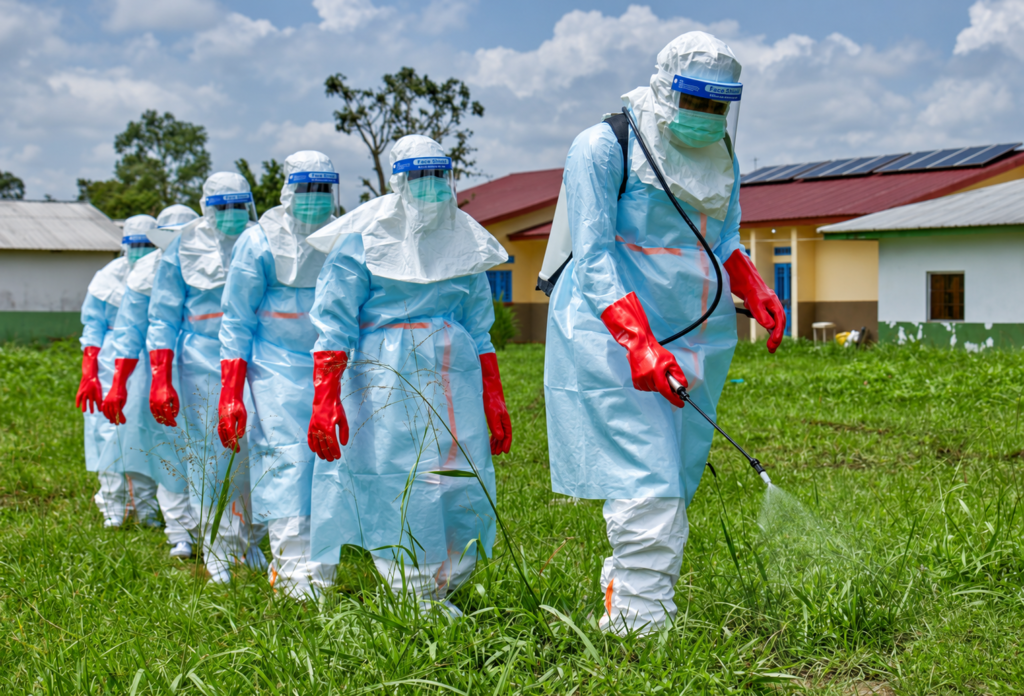
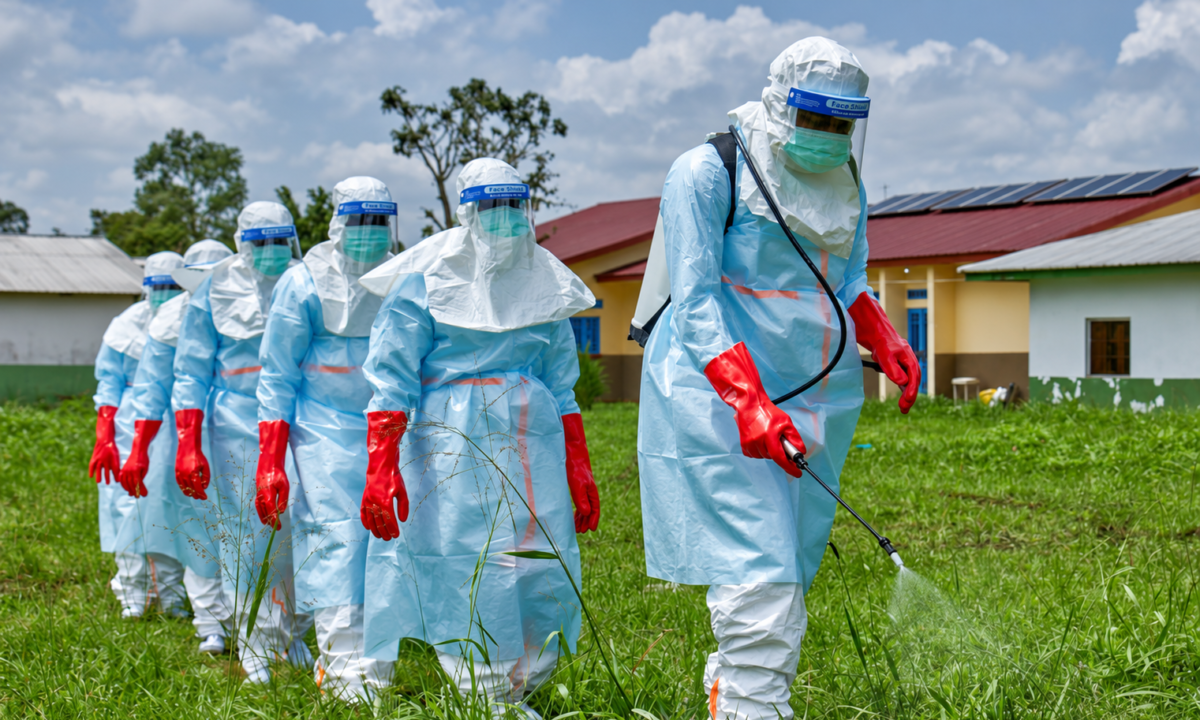
Health workers wearing protective equipment carry out a disinfection exercise. Illustrative image.
For 21 days, Nigerian health officials monitored 62 people who may have been exposed to Ebola.
Some developed fever and other symptoms. Each new illness carried the possibility that the virus had begun spreading within the country.
That did not happen.
All 62 contacts have now completed the monitoring period, and none contracted the virus. Thirteen developed symptoms during that time, but laboratory tests came back negative.
Health authorities also investigated seven suspected cases reported in Adamawa, Rivers, Borno, Lagos and Ekiti states. All seven tested negative.
The result means Nigeria has recorded no secondary transmission from the imported case, according to the Nigeria Centre for Disease Control and Prevention.
That is no small achievement.
Ebola spreads through direct contact with the bodily fluids of an infected person or with contaminated materials, including clothing and bedding. Once the virus enters a household or hospital without being recognised, the consequences can be devastating.
Finding the contacts, reaching them every day and quickly testing those who developed symptoms helped prevent one imported infection from becoming a national emergency, according to a Reuters report on the completion of the monitoring period.
But Nigeria is not yet officially free of Ebola.
Under World Health Organization protocols, the country must complete a 42-day countdown from the recovery or departure of the last confirmed patient before the outbreak can formally be declared over.
How the infection reached Nigeria
Nigeria confirmed the case on 20 October, its first recorded Ebola infection in more than a decade.
The patient was a Swiss woman who had travelled through Uganda before returning to Nigeria. She arrived in the country on 5 October and reportedly began feeling unwell two days later.
On 11 October, she sought treatment at a private hospital with symptoms that initially resembled malaria. Ebola was confirmed on 19 October.
The woman and her husband were later medically evacuated to Switzerland. She recovered and was discharged from hospital.
Once the infection was confirmed, Nigeria’s response moved quickly. Contact tracers identified 62 people who may have been exposed. Health officials activated surveillance, laboratory testing and public communication systems.
The response worked. But the events leading to the diagnosis should still concern health authorities.
An infected traveller entered Nigeria, developed symptoms and remained in the country for several days before Ebola was confirmed.
The system contained the danger after recognising it. It did not stop the infected traveller from passing through the country’s entry and healthcare systems before detection.
That gap matters because the next imported case may not end as successfully.
What Nigeria got right
The absence of secondary transmission shows that important parts of Nigeria’s disease-response system worked.
The infection was confirmed in a laboratory. Contacts were identified and monitored. People who developed symptoms were tested. Suspected cases reported in other states were investigated.
The NCDC Ebola dashboard also shows that screening has continued at 16 points of entry. By 16 November, health authorities had recorded nearly 697,000 screenings since 5 June.
Those figures point to an active surveillance operation.
But border screening has limits.
Officials depend on travellers providing accurate information about their health and recent movements. They must also be able to recognise possible symptoms. A person in the incubation period can carry the virus without appearing ill.
A temperature check at an airport cannot detect every infected traveller.
This is why hospitals, clinics and laboratories are just as important as border controls.
The confirmed patient first sought treatment at a private hospital with symptoms resembling malaria. That would not be unusual in Nigeria, where fever is often treated as malaria before other possibilities are considered.
Unless healthcare workers ask about recent travel and recognise the warning signs, a rare but dangerous infection can easily be missed.
The next patient may not enter a well-equipped hospital in Abuja. The person could appear at a small private clinic, a rural health centre or a hospital in a state with limited isolation facilities and slow access to specialised laboratories.
Would an ordinary hospital recognise the danger?
Nigeria’s preparedness cannot be judged only by what happens at international airports, federal hospitals or NCDC headquarters.
The real test may come in an ordinary consulting room.
Can a nurse recognise that a patient’s fever, vomiting or weakness may be connected to recent travel?
Can a doctor report a suspected case immediately without waiting for the patient’s condition to worsen?
Does the hospital have protective equipment, an isolation space and a clear procedure for alerting health authorities?
If the answer depends on the hospital, the state or the personal experience of the health worker on duty, then serious gaps remain.
Nigeria’s response system must reach beyond major cities. Healthcare workers in smaller facilities need current information, practical training and clear reporting channels.
They should not be learning about an outbreak from WhatsApp messages or social-media posts after a suspected patient has already entered their hospital.
Trust is also essential.
A person who fears being stigmatised, publicly identified or forcibly isolated may conceal symptoms or travel history. Alarmist reporting can make that problem worse, pushing people away from hospitals and making contact tracing more difficult.
Government communication must therefore be clear and calm. Nigerians need accurate information about how Ebola spreads, what symptoms to watch for and where to seek help.
Before the case was confirmed, the NCDC said it had strengthened early detection, laboratory diagnosis, contact tracing, infection prevention and healthcare-worker protection in response to outbreaks elsewhere in Africa.
The successful monitoring of the 62 contacts suggests that those preparations made a difference.
But one contained case cannot prove that the entire national system is ready.
The work must continue after the countdown
Nigeria deserves credit for preventing one imported infection from becoming a chain of local transmission.
All 62 contacts completed monitoring. Those who developed symptoms tested negative. Suspected cases in several states were investigated. No healthcare workers were reported infected.
That is a genuine public health success.
It should also be treated as a warning.
Nigeria remains connected to the rest of Africa and the wider world through air travel, road networks, trade, migration and family movement. Another infected traveller could arrive through a different airport or cross a land border. The person may not disclose recent travel or may seek treatment at a facility with little experience of Ebola.
Health authorities should use the remaining countdown period to examine what happened between the patient’s arrival and her diagnosis.
Were opportunities for earlier detection missed at the point of entry?
Did the private hospital immediately recognise the importance of her travel history?
How quickly were the health workers who treated her protected?
Would the same response have been possible outside Abuja?
Asking these questions does not take anything away from the containment effort. It is how Nigeria prepares to repeat the success under more difficult circumstances.
The 62 contacts are now clear.
The harder test is whether Nigeria’s surveillance system remains alert after the emergency briefings stop, the public attention fades and Ebola is no longer dominating the headlines.