
OPINION | BY ROBINSON AFAMEFUNA AMBROSE
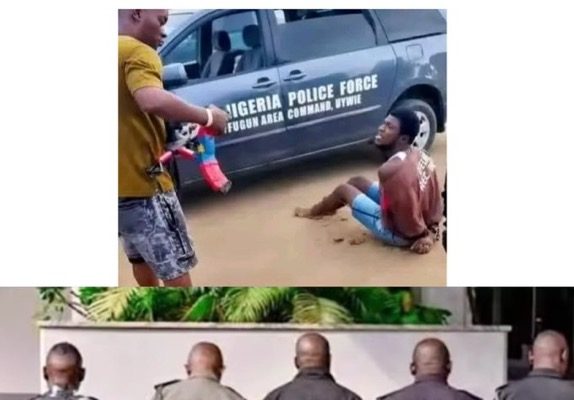
AI-generated illustration. This is not an original photograph or video still from the Zamfara incident.
A recent viral video circulating on social media shows a man leading young boys in a chilling chant, calling for assault rifles to attack Christians in Enugu and Plateau states. The participants wore uniforms resembling those of the Jama’atu Izalatil Bid’ah Wa Iqamatus Sunnah (JIBWIS) First Aid Group. JIBWIS quickly condemned the remarks, disowned the conduct, and clarified that the uniform did not mean the speaker was authorized to represent the organization. Read JIBWIS’s response.
According to the police, the video was recorded on 23 October in Maradun, Zamfara State. Authorities arrested the speaker, Umar Ibrahim, announcing their intention to charge him with breach of public peace, incitement of hatred, and criminal intimidation under the state penal code. As of late October 2026, while these state-level charges have been announced, no court verdict has been reached. A verification question remains: a fact-check found no evidence that the video was AI-generated, but could not independently establish its original recording date, location, or the identities of those shown. While police have since given their account of where and when it was recorded, that account should be rigorously tested as the investigation proceeds. Police account of the recording and announced charges.
TWO EXTREMES OF THE LAW: A TALE OF TWO CRACKDOWNS
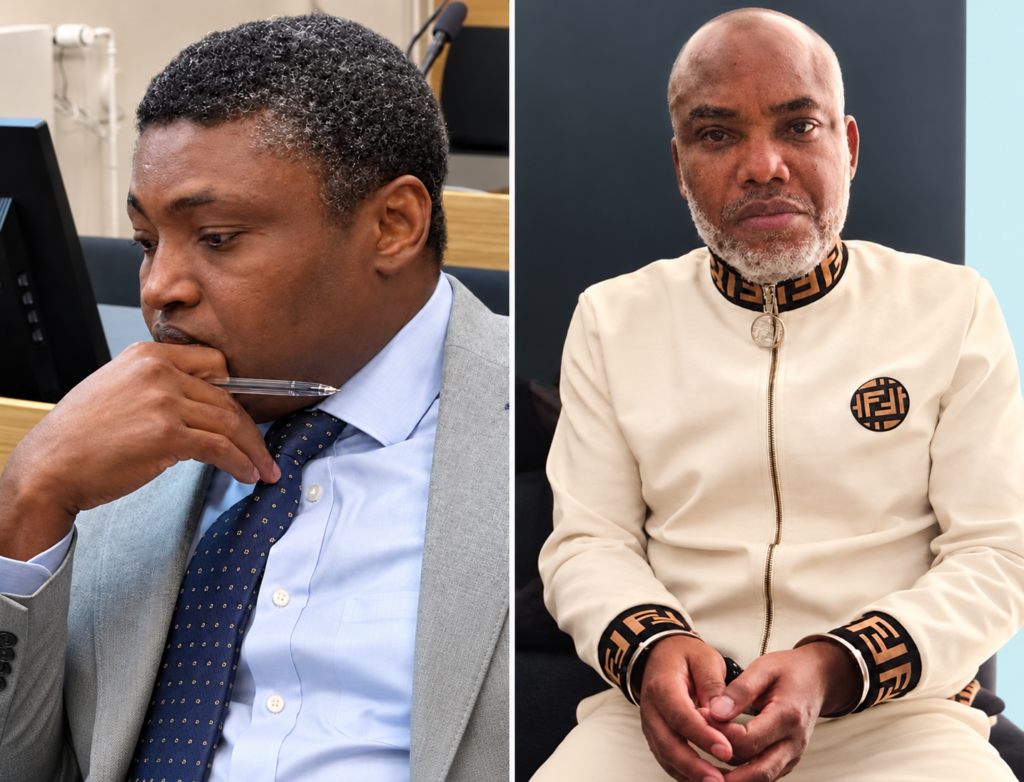
Illustrative portraits of Nnamdi Kanu (left) and Simon Ekpa (right
When Biafran speech is routinely branded as terrorism, what do we call an explicit threat to launch an armed attack on Enugu?
Consider the contrast. When the Federal High Court in Abuja delivered its judgment against IPOB leader Nnamdi Kanu on November 20, 2025, the state relied heavily on broadcasts it argued encouraged violence and intimidated the population. Read the court judgment. Similarly, on October 15, 2026, Finland’s Court of Appeal upheld the conviction of Simon Ekpa for participating in a terrorist group and publicly inciting crimes with terrorist intent, reducing his sentence from six years to four based on the circumstances. These are entirely different cases, tried in different countries under different legal frameworks. Ekpa was held accountable by a Finnish court, not Abuja. Yet, both cases demonstrate how forcefully authorities can act when speech is linked to Biafran separatism.
This stark contrast raises an uncomfortable question: Why does speech linked to Biafra trigger the full, immediate weight of anti-terrorism laws, while a public call for weapons to massacre Christians in Enugu is handled, at least initially, as a localized public-order offense?
Granted, the cases are not identical. But the core issue is whether threats against citizens based on their religion and ethnicity receive the same urgency, gravity, and state seriousness as speech threatening the corporate existence of Nigeria.
THE GLOBAL BLUEPRINT FOR INCITEMENT
The hesitation to treat this incitement with existential gravity stands in sharp contrast to international legal standards. The UN’s International Covenant on Civil and Political Rights protects religious practice and freedom of expression, but Article 20 explicitly states that advocacy of national, racial, or religious hatred that constitutes incitement to discrimination, hostility, or violence shall be prohibited by law. Furthermore, the UN’s Rabat Plan of Action offers a strict six-part test for assessing incitement, requiring authorities to evaluate the speaker’s influence, intent, the specific words used, their reach, and the definitive likelihood of harm.
International precedents show that cross-border hate speech targeting Nigerian ethnic groups can be treated with immense judicial severity. In the United Kingdom, Adeyinka Shoyemi, who operated online under the name Adeyinka Grandson, was jailed after being found guilty of eight counts of inciting racial hatred. His social media posts directly targeted ethnic groups in Nigeria, including the Igbo. The British judicial system did not view his rhetoric as a mere public-order disturbance; he was sentenced to four and a half years in prison in April 2022. Read about the conviction and sentence.
DOGMA, DEHUMANIZATION, AND INHERITED DIVISIONS
Why could these young men chant so confidently in the street, demanding AK-47s to kill Christians? The answer lies at a dangerous intersection of rigid theology and historical ethnic prejudice, perfectly captured by a common phrase used in Muslim-majority Hausa communities: “Mutum wanda baya sallah, shi ne arne ne” (A person who does not perform Islamic prayer is a non-believer).
In other words, they are singing the sinful tune passed down to them from the old divisions of their fathers. The chant reflects a belief these children have been taught, rather than words they invented on their own. An Igbo proverb notes, “Onye nna ya dunyeru ori na-eji ụkwụ agbawa ụzọ”, the person sent to steal by his father kicks the door open. The saying speaks directly to the absolute confidence that comes from believing an authority figure has granted you permission. The fundamental question raised by this video is not only why the children repeated these threats, but who taught them, who led the group, and what messages they had been systematically hearing.
This statement is a religious expression commonly used in Muslim-majority Hausa communities. It reflects a strictly orthodox Islamic theological viewpoint regarding the importance of daily prayers. In Islamic jurisprudence, many scholars emphasize that the deliberate and total abandonment of the five daily prayers (sallah) separates a person from the fold of Islam, essentially classifying them as a non-believer (arne).
Historically, arne (plural: arna) specifically meant “pagan” or “animist,” originally referring to people who practiced traditional African religions, such as the Maguzawa Hausas, rather than Islam or Christianity. Over the decades, however, as large populations of Christian Igbos migrated north, the term was loosely and pejoratively extended to them simply because they stood outside the Islamic faith. By utilizing the phrase, a radical speaker makes a sharp, weaponized point: If you do not pray, you are no better than the outsiders and Igbos we see around us.
This linguistic bigotry is well-documented. A lexicon on conflict and hate speech in Nigeria records that arne is frequently deployed by extremists to dehumanize Christians. In everyday northern settings, the word is routinely directed at Igbo people as a direct insult, or thinly veiled under the cover of a joke.
THE GEOGRAPHY OF ALIENATION
This prejudice is deeply tied to the history of urban segregation. Historical accounts of Northern urban centers, alongside comparative historical studies of migrant societies, show how colonial authorities systematically partitioned migrant quarters like Sabon Gari (new towns) and Unguwan Tasha. A study of southern migrants in Northern Nigeria documents the Gimi example. These quarters became the designated spaces for Yoruba, Ijaw, and predominantly Igbo families. Over generations, migration, religion, and ethnic identity became physically and socially intertwined, solidifying an “us versus them” dichotomy.
When the Zamfara video explicitly names Christians in Enugu, the geography is deliberate. Enugu carries an immense psychological and historical weight; it was the capital of the secessionist Republic of Biafra during the civil war. In Nigeria’s political imagination, Igbo identity is frequently treated as synonymous with Christianity. Therefore, a threat against Christians in Enugu carries both an explosive religious force and an unmistakable ethnic resonance.
AN UNEQUAL ARENA
This is the double standard laid bare: Biafra-linked speech brings down the full, iron fist of state terror prosecutions, while an explicit call to arm children for an attack on Enugu is treated as a routine misdemeanor. The Igbo are expected to maintain absolute faith in federal institutions to protect them, even while the political expressions associated with their region are treated as existential threats to the state.
This unequal enforcement creates a suffocating reality. It leaves the Igbo feeling as though their hands are tied behind their backs, even as they are forced into an arena to face an opponent armed with a dagger. Such unequal protection does nothing but deepen alienation and breathe fresh oxygen into separatist narratives. It serves as a direct answer to those who wonder why demands for Biafra persist. If the state demands that a people reject separation, yet fails to prove it will protect them equally, what reason does it give them to trust the union?
Citation List
[1] Police account of the video, location and announced charges
[2] Video verification findings
[3] Federal High Court judgment in the case of Nnamdi Kanu
[4] Finland Court of Appeal ruling on Simon Ekpa
[5] International Covenant on Civil and Political Rights, Article 20
[6] UN material on the Rabat Plan’s six-part test
[7] Adeyinka Shoyemi conviction and sentencing
[8] Social Media and Conflict in Nigeria: A Lexicon of Hate Speech Terms
[9] Shehu Tijjani Yusuf, “Trapped’in the North: Southern Migrants in Northern Nigeria, 1908–1970s,” Bayero University, Kano, p. 6. Bildschirmfoto 2026-10-31 um 09.54.30.png
[10] Historical account of migrant quarters in northern Nigeria